



As someone new to the health and social care sector, it’s essential to understand the Care Certificate standards. Across the UK health and social care settings, there are 16 national standards explaining the practices a health care worker should learn.
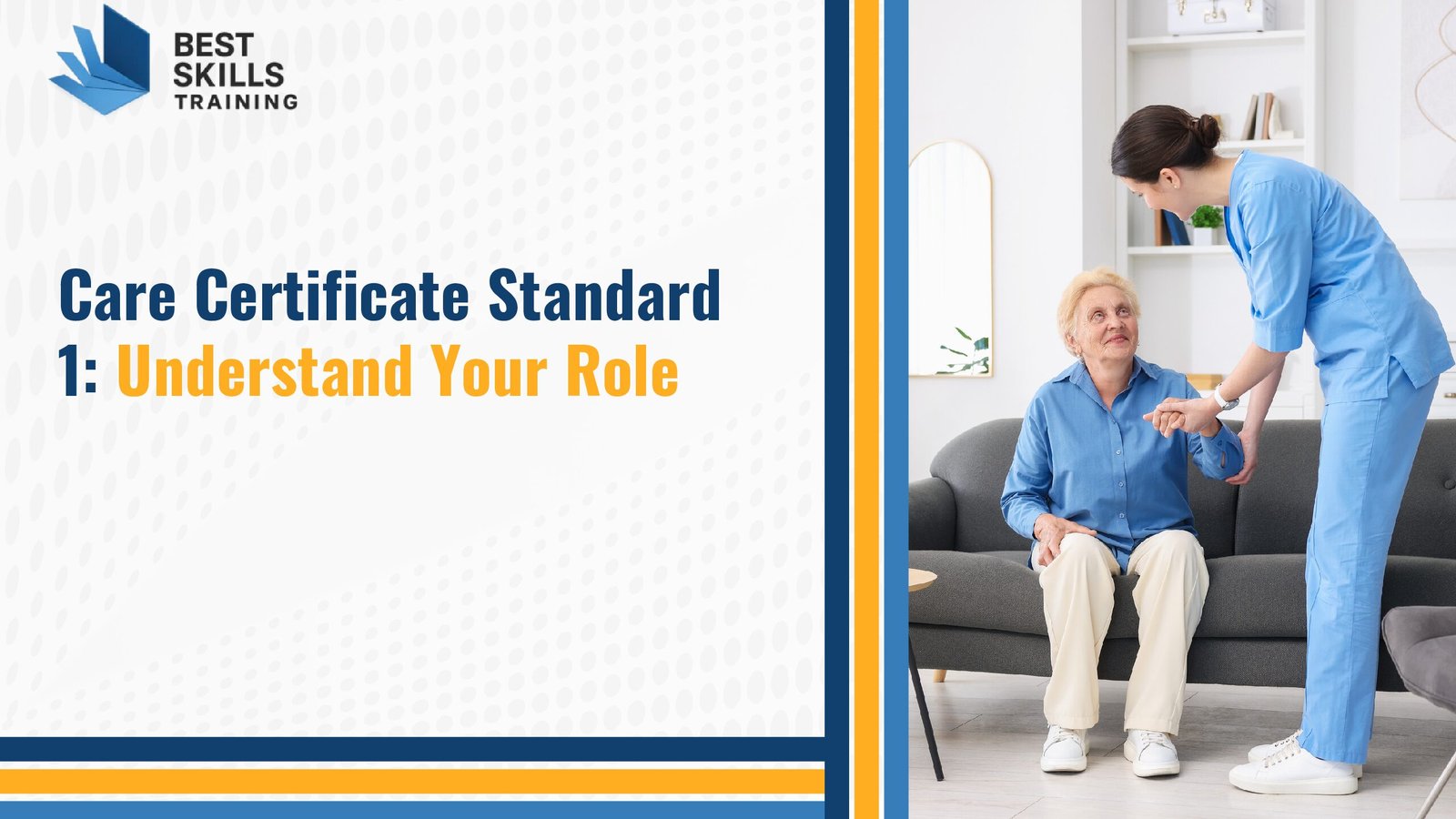
So, what is Care Certificate Standard 1? It’s the one that outlines the duties and responsibilities of a care worker. It’s called ‘Understand Your Role’, where you learn about your role, work procedures, relationships, and more.
Here, we are going to discuss what the Care Certificate Standard 1 means and your other relevant queries. Let’s start!
What is a Care Certificate?
The Care Certificate is a set of 16 national standards that outline the initial knowledge, skills and behaviours that all health and social care support workers are expected to have.
It is suitable for those new to the health and care sector, for example, as a healthcare assistant, support worker or adult social care worker, who are not regulated. It is not required for regulated health care providers such as nurses or doctors.
How does a Care Certificate work?
It’s a blend of theory and assessment in the workplace. Health and social care staff are required to achieve all standards (usually within 12 weeks) before they can work without direct supervision.

What are the 16 Care Certificate Standards?
Skills for Care, NHS England, and Skills for Health updated the standards in March 2025. They include the following:
- Understanding your role
- Personal development
- Duty of care
- Equality and diversity
- Person-centred approaches
- Communication
- Privacy and dignity
- Fluids and nutrition
- Recognising mental health, dementia and learning disability/autism (extended in 2025)
- Safeguarding adults
- Safeguarding children
- Basic life support
- Health and safety
- Handling information
- Infection prevention and control
- Awareness of learning disability and autism (added in the March 2025 update)
What is Care Certificate Standard 1?
The Care Certificate Standard 1 is called ‘Understand Your Role’. In this, new health and social care workers are taught about their role, responsibilities and how this fits into the wider care setting.
The key areas of Care Certificate Standard 1 are:
Job Description & Duties
- Knowledge of your tasks, responsibilities and limits
- What you do and do not have in your job role, as specified by your employer.
Agreed Ways of Working
- Compliance with the employer’s policies/procedures and agreed-upon care plan of the individual.
Duty of Care
- Upholding the social care or healthcare Code of Conduct, such as accountability, privacy, dignity and duty of care.

Working Relationships
- Understanding the difference between professional working relationships and personal relationships.
- It also helps develop good working relationships with colleagues, managers and others working with clients.
Rights and Responsibilities
- Understanding your employment rights (including health and safety, working hours and minimum wage)
- Your legal and ethical responsibilities.
Raising Concerns
- Being aware of how to report errors
- How to deal with uncertainty and conflict, and
- How to follow whistleblowing guidelines when you come across unsafe practices.
What are the 5 Standards of Care in Health and Social Care?
The 5 care standards, used by the Care Quality Commission (CQC) to inspect and assess health and social care services, are:
1. Safe
Ensuring the safety of service users from abuse, neglect and unintended harm (safe environment, medication management, staffing, etc.).
2. Effective
Care, treatment and support are effective; they are good for improving quality of life and using evidence-based practice.
3. Caring
Showing individuals compassion, kindness, dignity and respect and involving them in decisions regarding their daily life and care.
4. Responsive
Being sensitive to meeting people’s individual needs, preferences and communication needs, and responding to complaints and feedback appropriately.
5. Well led
Effective leadership, governance, culture and learning and/or innovation that promotes high quality person-centred care.
Can you work in care without a Care Certificate?
Yes, you can work in a care role without a Care Certificate. It is not a legal or statutory qualification; however, it’s a crucial part of your induction.
Let’s understand how you can work in a care role without a Care Certificate.
- Not a legal requirement: It is not a legal or statutory qualification that you are required to have before taking a job. The Care Certificate is part of an induction standard.
- Completed on the job: Most employers recruit staff with no experience or qualifications. They require you to complete the Care Certificate during the early days of your job, typically in your first 12 weeks.
- Care Quality Commission (CQC): These are not a pre-employment law, but the CQC expects that care providers will ensure that staff are inducted, trained and assessed as competent before working unsupervised.
- 16 Standards: The 16 standards are incorporated, covering essential topics such as duty of care, safeguarding, basic life support and learning disability and autism awareness.
How Do I Obtain a Care Certificate? A Helpful Guide
The Care Certificate can be obtained by working through an employer-led induction programme in your workplace – this could be in an NHS trust, a residential care home or a domiciliary care provider.
CPD-certified Care Certificate Course
Enrol Now
The process: how does it work?
Step 1:
It is not possible to get an official Care Certificate before you get a job. It always has to be completed by your employer before you can start a job.
Step 2: Understand and apply 16 standards
Learn and apply knowledge to 16 standards (bearing in mind there is a new standard on learning disability and autism awareness).
Step 3: Combine practical assessment and theory
You do the theory part (usually free), and your workplace manager and/or assessor sign off on your practical component at work.
Step 4: Complete the 12 weeks
Most care providers expect you to complete all 16 standards within 12 weeks of commencing your role.
Important Tips for you!
- Not all online courses are the Care Certificate
If you purchase an independent online training or CPD-accredited course, you will receive knowledge or a theory certificate. However, it’s not necessarily the official Care Certificate. This can only be signed off by your employer.
- The Care Certificate is not time-limited. Once your employer has awarded it, you can take it with you to your next health or social care employer.
Frequently Asked Questions (FAQs)
How do I access my Care Certificate?
The certificate is fully transferable between any health and social care employers in the UK, which will allow you to save the training if you move roles.
How long does it take to get a Care Certificate?
The Care Certificate is a programme that takes 12 weeks to complete for someone working full-time, but can be completed in 8 to 11 weeks for someone who works part-time or at a faster pace.
Does a Care Certificate count as a qualification?
Yes, the Care Certificate is not a formal or regulated certification. However, it’s an industry-recognised induction framework of 16 standards.
It provides a baseline of knowledge, skills and behaviours that must be expected to work safely in health and social care.
Conclusion
Now that we have learned about the Care Certificate Standard 1, it helps us comprehend its importance. Before we become competent in a role, the first step is to build our knowledge of that role, including ‘what it does, how it helps, and what elements are crucial in this’.
As a health and social care worker in the UK, having a Care Certificate is a must. For that, understanding the 16 care standards is a crucial requirement.