



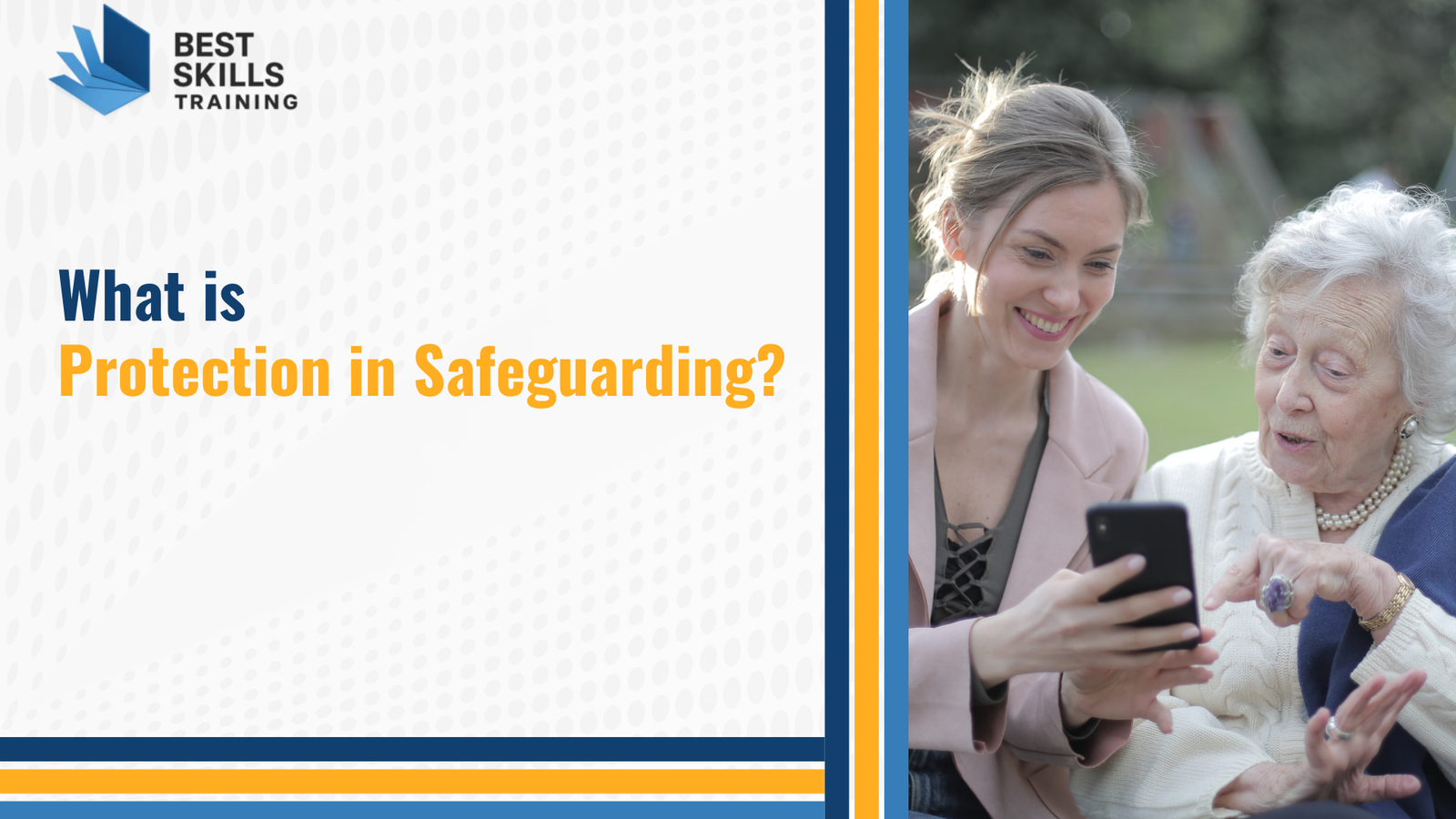
What is protection in safeguarding? It means acting to keep someone safe from abuse, neglect or other harm, and making sure they’re heard and supported once that risk shows up.
People use the word “protection” in three different ways, and it’s easy to get them mixed up. Sometimes it just means the everyday act of stopping harm. Sometimes it’s the name of one of six safeguarding principles used with adults in England. And in children’s services, “child protection” means something more specific again: the formal response when a child is suffering, or likely to suffer, significant harm. Safeguarding sits above all of this as the wider umbrella term. It covers preventing harm, protecting people from it, and promoting someone’s wellbeing while respecting their own views, working with people and organisations. Protection is the piece of that umbrella concerned with harm that’s happening right now.
This guide untangles those three meanings, places protection alongside the other five principles, and covers a few parts of the system that most articles skip. It’s aimed at care workers, managers, teachers, volunteers and anyone studying safeguarding across the UK. The law isn’t the same in England, Scotland, Wales and Northern Ireland, so each section says where it applies.
What Is Protection in Safeguarding?
So, what is protection in safeguarding, beyond the dictionary definition? The Care Act guidance provides protection: an “I statement” written from the adult’s own point of view. It says they get help to report abuse and take part in the process as much as they want and can. Where someone has real difficulty being involved, and there’s no one else appropriate to support them, the Care Act provides for an independent advocate.
That duty isn’t unlimited, though. It only applies where an adult has care and support needs, is at risk of abuse or neglect, and can’t protect themselves because of those needs. And CQC Regulation 13 backs this up on the provider side: any allegation has to be investigated immediately, as soon as staff become aware of it.

The Three Ways the Term Is Used
Day-to-day, protection just means taking steps to prevent harm or reduce risk, whether that’s reporting a concern or ensuring someone’s immediate safety. There’s no single legal definition of it in this everyday sense, and it applies everywhere, from a hospital ward to a youth club.
The second use is the protection principle in adult safeguarding, one of six set out in the Care and Support Statutory Guidance. This one’s specific to adult safeguarding in England.
The third is child protection. The NSPCC frames it as part of the wider safeguarding process but focuses on individual children who are suffering or at risk of significant harm, including procedures for handling such concerns in England, as set out in the Children Act 1989 and Working Together to Safeguard Children. Scotland, Wales and Northern Ireland each run their own version.
What Is the Protection Principle in Safeguarding?
The protection principle comes from the guidance behind the Care Act 2014, which describes it as “support and representation for those in greatest need.”
Break that down, and there are really three parts to it. First, help to speak up, so the person actually knows how to raise a concern. Second, support throughout the process itself, since meetings, forms, and being questioned can be genuinely hard for some people. Third, representation, meaning someone speaks up for what the person themselves wants, not just for how the organisation sees the risk.
None of this means taking over someone’s decisions. It’s meant to work alongside empowerment and proportionality, not instead of them.
Here’s an illustrative scenario, not a real case. A resident with dementia tells her carer that a night worker handles her roughly. The carer stays with her, reports it to the manager, and the local authority gets informed. Because she struggles with meetings, someone she trusts helps her say what she actually wants to happen next.
Why Is Protection Important in Safeguarding?
Some people simply can’t protect themselves. In England, the local authority’s duty to look into a concern kicks in specifically where someone has care and support needs, is at risk of abuse or neglect, and can’t protect themselves because of those needs. That’s the whole reason protection exists as a principle.
Harm also tends to stay hidden. People who are being abused might not recognise it as abuse, might be scared of what happens if they speak up, or simply might not know how to report it. Protection actually puts the responsibility back on the people around them to notice and act.
Safeguarding Training Level 3
Enrol Now
What Are the Six Principles of Safeguarding?
The six are empowerment, prevention, proportionality, protection, partnership and accountability. Sections 42 to 47 of the Care Act put safeguarding on a statutory footing, but the six principles themselves come from the guidance that supports the Act, not the Act’s own text. SCIE notes they build on the Mental Capacity Act 2005 and the Human Rights Act 1998.
Empowerment
Empowerment means people are supported in making their own decisions and giving informed consent. The guidance also supports an approach called Making Safeguarding Personal, which focuses on the person rather than the process and asks what outcome they want before making any decisions.
Take a woman with a learning disability who wants to keep seeing a friend whose behaviour worries staff. Empowerment here means working out what would make that contact safer, rather than simply banning it.
Prevention
Prevention means acting on early signs and reducing risk before harm occurs. Think staff training, safer recruitment, clear information for people using services, and tackling isolation before it becomes a bigger problem.

Proportionality
Proportionality means matching the response to the likelihood and seriousness of the risk, using the least intrusive approach that still works. SCIE’s warning here is worth remembering: over-intervention damages trust just as much as under-intervention leaves people exposed.
An occasional missed dose of medication might just need a quick review and a conversation. Repeated, deliberate withholding of medication is a different matter entirely and needs a formal response.
Protection
Protection is covered fully above. It’s the principle that kicks in when someone needs help being heard, supported or represented, and it only really works alongside empowerment and proportionality.
Partnership
Partnership means local authorities, police, NHS bodies, providers and communities actually working together, not in silos. Partner agencies have a duty under the Care Act to cooperate, which, in practice, means sharing information appropriately rather than leaving one worker to carry a concern on their own.
Accountability
Accountability works at three levels, and most guides collapse these into one line. Worth separating them. At the system level, a Safeguarding Adults Review under section 44 of the Care Act gets triggered when an adult has died or been seriously harmed, and there’s a question over how agencies worked together. At the organisational level, CQC Regulation 17 demands an auditable trail: who was told what, and when. Regulation 20 goes further and requires organisations to be open when something’s gone wrong.
At the individual level, accountability follows the person rather than the employer. A registered professional can face fitness-to-practise proceedings from their own regulator, whatever their employer did or didn’t do, and the Public Interest Disclosure Act 1998 protects anyone who raises a genuine concern from being penalised for it.
Do the Six Principles Apply to Children?
Not officially, no. They were written specifically for adult safeguarding in England. Children’s safeguarding is based on Working Together to Safeguard Children, and in schools and colleges, on Keeping Children Safe in Education. The 2026 edition of Working Together replaced the 2023 version. These documents address entirely different concepts, including a child-centred approach, early help, and “significant harm.” In the other UK nations, use whichever child protection framework applies there.
How Do Protection, Prevention and Proportionality Differ?
These three blur together easily, so it helps to ask what question each one is actually answering. Prevention asks how to stop harm from happening in the first place. Protection asks what help and representation someone needs now that they’re at risk or already harmed. Proportionality asks how much intervention is actually justified at each decision point.
Prevention happens before harm, through training and safer recruitment. Protection kicks in once risk or harm has been spotted, through reporting or an advocate. Proportionality runs through every step, shaping the choice between a supportive conversation and a formal referral.
Skip prevention and harm goes unnoticed until it’s a crisis. Skip protection, and the person’s left to navigate the system alone. Skip proportionality, and you end up either heavy-handed or too soft.
How Are the Principles Applied in UK Settings?
Use the adult principles in adult services in England, and whichever child safeguarding framework applies in your nation when working with children. Plenty of settings deal with both, and honestly, most of the confusion sits in the practical machinery behind the principles rather than the principles themselves.
One bit of that machinery rarely gets explained properly: the Multi-Agency Safeguarding Hub, or MASH. Most English local authorities now run one. It brings police, children’s social care, and health professionals into a single team, so a referral is reviewed by all relevant agencies at once, rather than being passed slowly between departments. Some areas run an adult version alongside it. If you’ve ever wondered what actually happens between reporting a concern and hearing anything back, this is usually the answer.
Inspection ties into all this, too. CQC’s single assessment framework treats safeguarding as a named quality statement for both individual providers and the overall performance of a local authority area. Where things look seriously wrong, Ofsted can join forces with the police inspectorate and the CQC for a joint targeted area inspection, looking at how agencies handle a specific issue like domestic abuse or criminal exploitation together.
In care homes and domiciliary care settings, providers must meet CQC Regulation 13, with safeguarding training built into the induction process. Domiciliary care has a risk that’s easy to overlook: the workers are often completely alone in someone’s home. Employers are expected to conduct lone-working risk assessments and provide staff with a quick way to reach an on-call manager.
In the NHS, safeguarding runs through a supervision structure most patients never even see. Integrated Care Boards employ named nurses and named doctors for safeguarding, whose job is to advise, supervise frontline staff, and bridge the gap between clinical teams and the wider multi-agency system.
In schools and colleges, Keeping Children Safe in Education is statutory guidance under section 175 of the Education Act 2002. The 2026 edition took effect on 1 September 2026, dropped the shortened Annex A, and now expects every member of staff to read Part One in full.
In charities and sports clubs, trustees in England and Wales must take reasonable steps to protect anyone who comes into contact with their organisation, even if day-to-day safeguarding is delegated to a named lead. And it’s worth knowing this reaches further than the obvious settings: prisons and immigration removal centres carry their own safeguarding responsibilities too, including spotting potential victims of modern slavery through the National Referral Mechanism.
Examples of Safeguarding
For adults, the Care Act guidance lists ten categories of abuse: physical, domestic, sexual, psychological, financial or material abuse, modern slavery, discriminatory abuse, organisational abuse, neglect and acts of omission, and self-neglect. Self-neglect stands apart from the rest. It can mean someone’s unable or unwilling to look after their own hygiene, health, or surroundings, and it often overlaps with hoarding, which can involve the fire service because of the genuine fire risk.
For children, abuse generally falls into physical, emotional and sexual abuse, and neglect. But two other patterns matter more and more in practice, and they’re still poorly explained on many training sites. Criminal exploitation, including county lines, is where children or adults get groomed into moving drugs or money across force boundaries. It’s treated as a safeguarding issue now, not just a policing one.
Cuckooing is the adult version, where someone’s home gets taken over to facilitate dealing, usually targeting someone isolated or with care needs. Mate crime is exploitation by someone posing as a friend, most often affecting adults with a learning disability, and it’s worth knowing the term specifically because it rarely looks like abuse from the outside.
There’s also a category under the Prevent Duty. The Counter-Terrorism and Security Act 2015 puts a duty on schools, health bodies, local authorities and prisons to have due regard to preventing people from being drawn into terrorism. Where a concern meets the threshold, the Channel programme offers tailored, voluntary support.
A few worked examples make this more concrete. A resident with unexplained bruises needs their safety to be checked, a report to the manager, the facts recorded, and a review of moving and handling practice. If an adult says a relative’s taking their money and asks you not to tell anyone, don’t promise secrecy. Explain what you have to do, report it, and support them to say what they want to happen.
An older resident who’s stopped answering the door, with a home that’s grown cluttered and unsafe, points to self-neglect and needs a care needs assessment, plus, if there’s fire risk, a referral to the fire service. A teenager who suddenly has expensive new things, goes missing overnight, and seems frightened of someone outside the family fits a pattern often linked to criminal exploitation and needs a referral into the local authority’s exploitation pathway rather than being treated as simply a behaviour problem.
Who Is Responsible for Safeguarding?
A Director of Children’s Services carries area-wide accountability for the performance of children’s social care. A Director of Adult Social Services is responsible for adult safeguarding. Allegations against someone who works with children go to a Local Authority Designated Officer, a separate role from a school’s Designated Safeguarding Lead. That’s also why Safeguarding Adults Boards are usually chaired independently of any partner agency, and why elected council members carry a scrutiny role over what those Boards find.
Who Is Responsible for Safeguarding Children?
In England, the three statutory safeguarding partners are the local authority, the police and the health service. Children’s social care assesses referrals under sections 17 and 47 of the Children Act. Beyond those operational roles, the family court can grant an emergency protection order or a care order under the Children Act 1989, providing a legal basis for removing a child from immediate danger. Over in Wales, relevant partners are required to alert the local authority the moment they suspect a child is at risk.

Who Is Responsible for Safeguarding Adults?
In England, the local authority takes the lead. Once the conditions in section 42 are met, it must carry out the necessary enquiries itself or arrange for someone else to do so. In Scotland, the Adult Support and Protection Act puts a legal duty on councils, and multi-agency Adult Protection Committees report to Scottish Ministers every two years. In Northern Ireland, adult safeguarding still runs under a 2015 policy.
An Adult Protection Bill was introduced in 2025 to put adult protection on a statutory footing for the first time, following failings at settings including Dunmurry Manor and Muckamore Abbey Hospital. As of September 2026, it remained a Bill, not a law, so it’s worth checking its current status before relying on it.
Employers, Professionals and Organisations
CQC-regulated providers have to put robust procedures in place, with overall responsibility at the board level rather than being handed off entirely to a single named lead. Individual professionals carry personal responsibility too, separate from their employer. This split, an organisation’s duty on one side and a professional’s personal accountability on the other, is one of the things people get wrong most often.
Safeguarding Procedures: What to Do if You Have a Safeguarding Concern
An organisation’s safeguarding policy sets out what it will do, and the procedures are the practical steps that underpin that policy. Local multi-agency procedures then govern how referrals to the local authority actually work. In Wales, these are called the Wales Safeguarding Procedures. Always follow your employer’s procedure first, since it’ll name your safeguarding lead and local contacts.
Recognise the Concern
Anyone can raise a safeguarding concern. You don’t need proof, and you don’t need to work out whether it meets some legal threshold. If you’re in doubt, raise it anyway.
Respond and Report
Make sure the person’s safe and get medical help if it’s needed. Listen calmly, without promising confidentiality or trying to investigate yourself. Report it promptly to your safeguarding lead, within whatever timescale your policy sets out. If the concern involves your own lead or manager, go to a senior colleague or the local authority instead.
Record and Share Information Appropriately
Write down what you saw or heard, with the date and time, using the person’s own words where you can. Keep the record secure and share it only with people who genuinely need it. Data protection isn’t a barrier here either: Working Together makes it clear that the Data Protection Act 2018 and the GDPR don’t prevent information from being shared to keep children safe.
What Happens After You Report?
For adults in England, the local authority decides whether its section 42 duty applies, then makes or arranges enquiries. Even where that duty isn’t triggered, the guidance still allows enquiries if it’s proportionate to do so. For children, the referral goes to children’s social care for assessment under sections 17 and 47. You might not hear the outcome in detail, since confidentiality usually applies.
When Should You Call 999?
Call 999 if someone’s in immediate danger, seriously injured or ill, or a crime’s in progress. Do that first, and tell your safeguarding lead afterwards. For anything that isn’t an emergency, the NSPCC helpline is 0808 800 5000, and Childline is 0800 1111.
What Laws and Guidance Support Safeguarding in the UK?
Acts and regulations are the actual law. Statutory guidance sits just below that; it has to be followed unless there’s a genuinely good reason not to. In England, adult safeguarding is built on the Care Act 2014, sections 42 to 47, plus Chapter 14 of the Care and Support Statutory Guidance, which was last updated in July 2025 and is currently being reviewed. For children, the key sources are the Children Act of 1989 and 2004, along with Working Together to Safeguard Children 2026 and Keeping Children Safe in Education 2026.
Wales works from Part 7 of the Social Services and Well-being (Wales) Act 2014. Scotland relies on the Adult Support and Protection (Scotland) Act 2007. Northern Ireland still uses its 2015 adult safeguarding policy alongside the Safeguarding Vulnerable Groups (Northern Ireland) Order 2007, with that Adult Protection Bill being the one worth watching going forward.
One thing worth flagging on terminology: “adult at risk” doesn’t mean quite the same thing everywhere. Scotland’s Act applies to anyone 16 or over, while Wales’s Act sets the age at 18. As for “vulnerable adult”, that phrase has mostly disappeared from use since the Care Act 2014 came into effect.
Common Misunderstandings About Protection in Safeguarding
A lot of people assume protection means taking control. It really doesn’t. The Mental Capacity Act starts from the position that anyone aged 16 or over can make their own decisions, unless there’s evidence to the contrary. And if an adult has capacity, they’re allowed to make choices other people might think are unwise. That’s genuinely their right.
Protection also isn’t the same as child protection. Child protection is a formal part of children’s safeguarding, whereas protection, as a principle, applies to adults. And the six principles aren’t written into the Care Act itself. They sit in the statutory guidance issued under it.
Some people think a concern needs to meet a legal threshold before it’s worth raising. It doesn’t. Anyone can raise something, and you don’t need to be sure of anything first. When in doubt, raise it.
FAQ
1. What Does Protection Mean in Safeguarding?
Protection means taking action to keep someone safe when they’re being harmed, or are genuinely at risk of harm. This is one part of protection, along with preventing harm and promoting someone’s well-being. In adult safeguarding in England specifically, protection is also one of six key principles set out in the Care Act 2014 guidance.
2. What Is the Protection Principle in Safeguarding?
The protection principle is included in the Care and Support Statutory Guidance, which is part of the Care Act 2014. In practice, this involves supporting and advocating for those who are most likely to be at risk or subject to harm or abuse. It could be assisting someone who has experienced abuse or neglect to report it, or, where required, arranging an advocate to ensure someone’s wishes and views are heard.
3. What Is the Difference Between Safeguarding and Protection?
Safeguarding is the broader issue of keeping people safe at all times, preventing harm, and promoting wellbeing. Protection is narrower; it’s about responding once someone is at risk or has already been harmed. Child protection narrows this even further, coming into play specifically when a child is suffering, or is likely to suffer, significant harm.
4. What Should You Do if You Have a Safeguarding Concern?
Firstly, ensure the person’s safety. If there is an immediate danger, dial 999 for immediate help. Pay attention and don’t make promises to keep the information they share confidential. Report to your safeguarding lead as soon as possible and adhere to your organisation’s procedure. Record your observations clearly, be careful where you record them, and only tell those who need to know.
Conclusion
So, what is protection in safeguarding, ultimately? It’s a simple idea with a few layers. At its core, it’s what happens when someone’s at risk of harm: people notice, act, and make sure that person’s supported and heard throughout. In adult safeguarding in England, it’s also a named principle, meaning support and representation for those in greatest need. In children’s services, its formal counterpart is child protection, one piece of a wider system that runs on multi-agency hubs, named professionals, independent reviews, and personal professional accountability, all working away in the background.
When it comes to habits, one takeaway is to raise concerns when you are concerned about something. There is no need to prove it or be sure of it, nor to do your own investigation. If someone is at risk of harm, follow your organisation’s procedure and dial 999; always put the person’s wishes at the heart of the next steps.